A clean break from Earth
The four Artemis II astronauts have lit Orion’s engine and started the long, careful swing toward the moon, a move that locks NASA into the first crewed lunar flyby in more than half a century. Small milestone, large expense, familiar pattern.
On Thursday, the capsule’s engine burned for just under six minutes, providing enough thrust to push the spacecraft onto a three-day trip toward the moon. NASA said the burn would accelerate a stopped car to highway speed in less than three seconds, which is one way to remind everyone that space travel is still trying very hard to be dramatic.
Mission control in Houston signaled the engine run was going well: “Looks like a good burn, we’re confirming.”
From aboard Orion, astronaut Jeremy Hansen sounded suitably upbeat. “The crew is feeling pretty good up here on our way to the moon,” he said. “Humanity has once again shown what we are capable of.”
The engine firing came a day after the huge orange and white Space Launch System rocket lifted Orion off flawlessly from Kennedy Space Center in Florida for the long-awaited journey.
No turning back now
The astronauts are now on a so-called free return path, meaning the moon’s gravity will swing them around and send them back toward Earth without additional propulsion. Once they are on that track, there is no easy detour. Space, annoyingly, does not do do-overs.
The crew’s suits are also designed as survival systems. If there is a cabin depressurization or leak, the suits can supply oxygen, regulate temperature and maintain the proper pressure for up to six days.
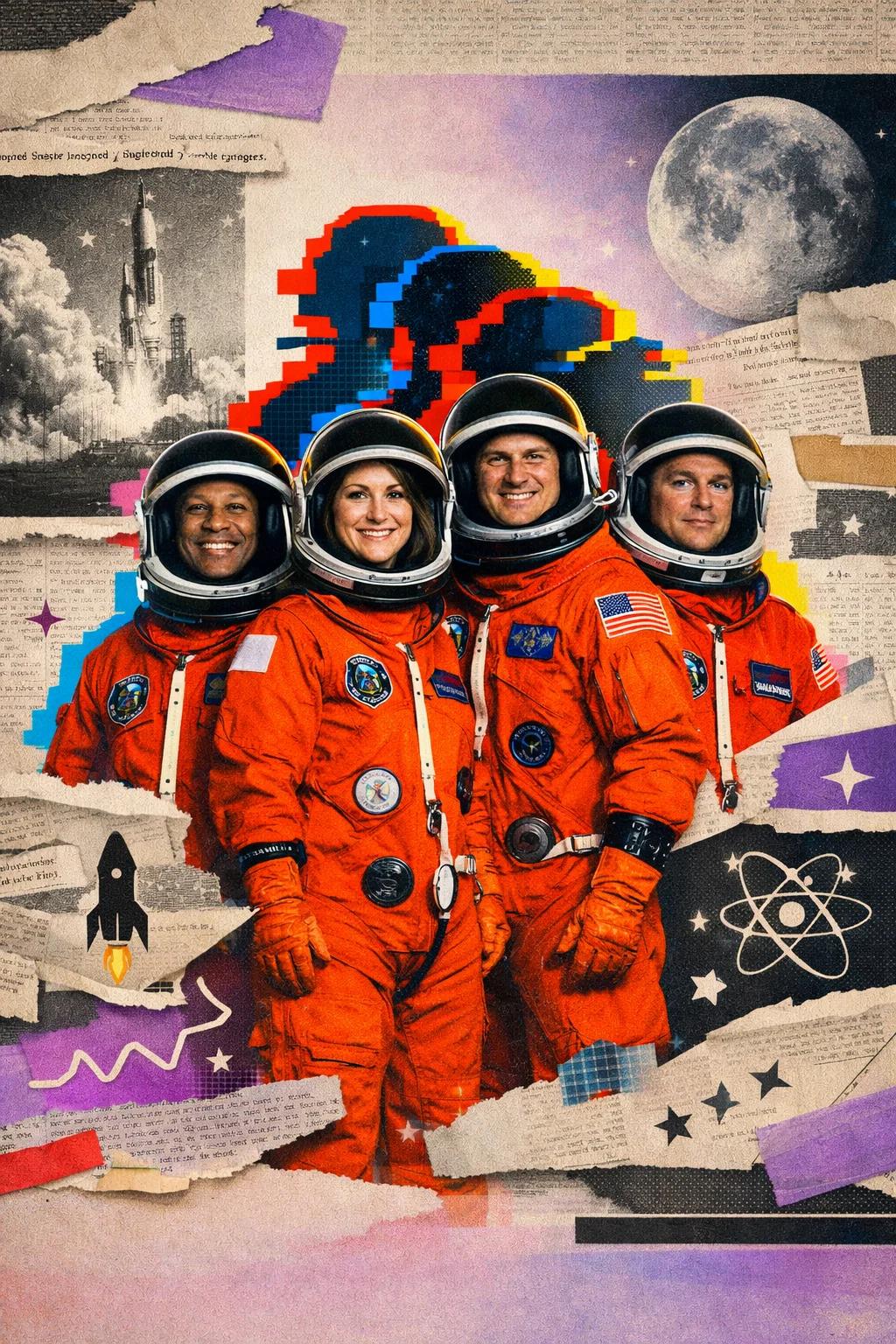
The astronauts, Americans Reid Wiseman, Victor Glover and Christina Koch, and Canadian Jeremy Hansen, spent their first hours in orbit checking systems and dealing with minor problems on the spacecraft, including a communications issue and a malfunctioning toilet. Not exactly the glamorous side of deep-space travel, but the moon apparently does not care about presentation.
They began the second day of the mission by listening to Green Light by John Legend and André 3000, NASA said, a nod to the go-ahead they were about to receive for the burn that sent them onward.
They also used the spacecraft’s flywheel exercise device for the first time. Each astronaut is set to spend 30 minutes a day exercising to reduce the muscle and bone loss that comes with living without gravity.
A mission loaded with firsts
The 10-day Artemis II mission is intended to clear the path for a moon landing in 2028.
It also carries a long list of firsts:
- the first person of colour on a lunar mission
- the first woman on a lunar mission
- the first non-American on a lunar mission
If everything goes according to plan, the crew will also travel farther from Earth than any human has before, more than 250,000 miles, or 402,336 kilometers.
This flight is the first crewed mission of SLS, NASA’s new lunar rocket. The rocket is meant to help the US return to the moon repeatedly and eventually support a permanent base that could serve as a platform for deeper exploration.
Delays, politics and a race nobody asked for
SLS was originally supposed to fly in February, after years of delays and major cost overruns. More setbacks followed, including a return to the hangar for repairs.
NASA’s renewed push toward the moon has often been framed as a response to China, which wants to land humans on the moon by 2030.
At a post-launch briefing, Jared Isaacman, the NASA administrator, said that competition can help a country focus its resources.
“Competition can be a good thing,” he said. “And we certainly have competition now.”
The Artemis program has also faced pressure from Trump, who has urged NASA to move faster in hopes of putting boots on the lunar surface before his second term ends in early 2029. The target date of 2028 has made some experts skeptical, especially because the agency is leaning heavily on private companies for much of the technology.
The crew ended its press conference by talking about the mission’s significance, the adjustment to life in space and the view of Earth, which they described as spectacular.
Wiseman said that when the crew saw Earth as a whole, it stopped them in their tracks.
“You can see the entire globe from pole to pole, you can see Africa, Europe, and if you look closely, the northern lights,” he said. “It was the most spectacular moment and it paused all four of us in our tracks.”